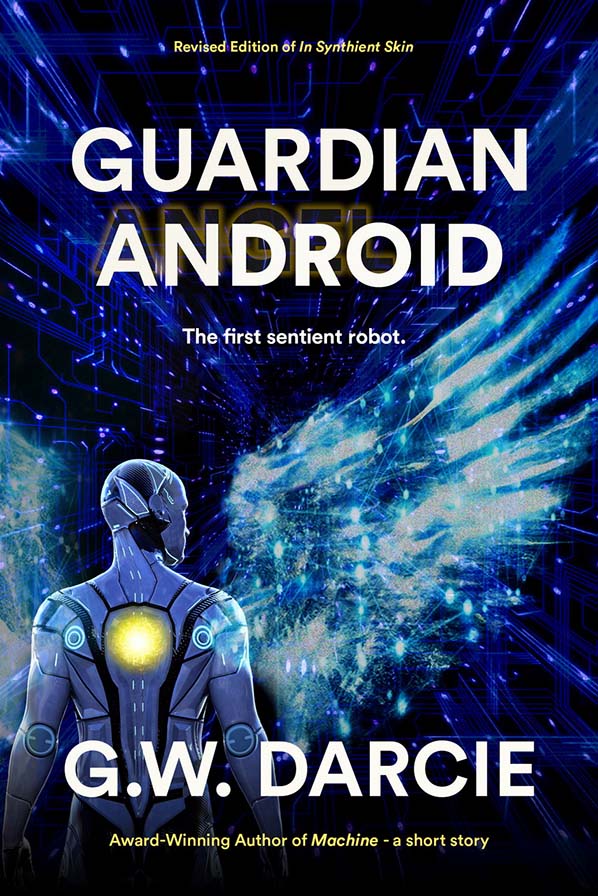
by GWDarcie | Sep 4, 2022 | Robotech
You think I’m talking about the science of gears and wires and stuff, you know, what robots are made from? Sorry, I know diddly about all that. No, I’m talking about brain science.
It’s not rocket science. No, it’s profoundly harder. It’s deep science. Rocket science is actually a branch of aerospace engineering, and all rocket science problems can be solved with math. It’s no biggie. (Okay, so if you don’t know any math, it’s going to be hard.)
My point here, is that rocket science is grade-school stuff compared to brain science. And before you go getting all starry-eyed, no, I know diddly about brain science, too. So why and I talking about it?
Because maybe you’re one of the unique few who finds this stuff interesting. I know I sure do. Personally, I’ve always felt a sense of awe when learning about how my brain works. In an intimate sense, brain science is about our very selves and how we work; it’s about you, about me.
How does your brain make you you? How does it generate the experience that you live every moment? The questions are so unfathomable that most dare not dwell on them. For many, the questions would never occur to them. Our experience is just what it is. Few wonder why. Fewer still wonder how.
For brain scientists, these questions are their bread and butter. (Sorry, that’s an elder expression, meaning their basic diet, their main focus, their – I don’t know, how would you say it?)
I’m talking brain science because of robots! Robots need AI if they are to function autonomously, and current AI is woefully inadequate. So how do we build an AI that is functionally equivalent to the human brain?
We’re clever monkeys. We imitate. The most successful intelligent machine we know of is the human brain. (Biomechanism, I should have said, not machine. You caught that, right?) All we have to do is imitate that.
And therein lies the problem. If only it were just rocket science.
But we’re making progress. Neuroscience and AI go hand in hand. Each supports and benefits from the other. We learn about our own brains through our attempts to imitate them. The more we learn, the better our imitations become. If we continue down this path, it is inevitable that we will eventually succeed. What happens then?
Let the speculation begin!
Oh, it’s already begun? In Guardian Android (In Synthient Skin), you mean? Okay, I see your point.
But I’d love to hear what you wonder about your own brain, wondrous as it is. What do you notice about your inner experience that fascinates you? What mysteries do you think are unsolvable?
by GWDarcie | Jan 30, 2015 | Robotech
Hello and Welcome. This blog is about robot technology, present and near future. If you love robots, please join the conversation.
Robots have been a mainstay of science fiction since its early days, and now they are here. Today’s robots, however, are nothing like the robots of fiction. It turns out that building functional humanoid robots — androids — is unimaginably hard. Even in a world churning with mind-boggling new technologies, humanoid robots are still in a rudimentary stage of development. This blog is an exploration of the technologies required to bring advanced androids to life. At the very least, this will include the mechanical technologies and advanced materials that will go into chassis design, and the A.I. and neuromorphic/neuromimetic computing technologies that will control those chassis. I will also explore some of the ethical questions we need to be considering before we actually succeed, and the social implications of success.
Science fiction has always been a powerful way to explore the landscapes of possible futures. Many people equate “hard sci-fi” with dry and heavy technical descriptions, and unless they loved science class in school, expect not to like it. But “hard sci-fi” need not be dry. In fact, the whole notion of “hard science” has lost its meaning in recent years. At its core, all science is fuzzy. The traditionally hard sciences like physics, chemistry and math, have all come to accept the fundamental uncertainty that permeates existence. The traditionally “soft” sciences, on the other hand, like psychology and the social sciences, now employ rigorous scientific methods to investigate areas once thought to be unquantifiable, such as consciousness, happiness and love. Yes, there really is a serious science of love. As a result of these changes, “hard” science fiction now encompasses the full range of human experience.
Hard sci-fi can best be appreciated as a contrast to “fantasy” simply because it presents worlds and ideas that are scientifically plausible, unlike, say, dragons, sorcerers, vampires and zombies. Hard and soft science fiction , on the other hand, are not discrete things, but rather exist on a continuum, ranging from hard to soft. The more scientifically plausible the technology, the “harder” the science. Teleportation, faster-than-light travel and time travel are all, for now, implausible, and introduce a fantasy element into a story, softening it. The same is true, historically, of androids that are indistinguishable from humans. My upcoming novel, In Synthient Skin, pushes android consciousness into the hard end of the spectrum, while remaining a deeply human story.
While much of science fiction takes us to distant worlds and times, it is the near future that most interests some of us. We can not predict what the future will be like, but we can certainly have fun speculating. Fifty years from now we will not have dragons, but barring a catastrophe, we will most certainly have robots. They won’t magically or mysteriously be just like us. They will have to be painstakingly designed and constructed to be that way, and a tremendous amount of work is being done to give us a realistic blueprint for success. It is this work that will be our focus here.
But do we really want that success? This is one of the traditional questions that science-fiction has helped us explore. I am currently working on a robot trilogy that brings this question into modern focus, something that becomes increasingly urgent as technology surges ahead. There is still time to shape the future. Please contribute by adding your voice.
If you are interested in these topics, I suggest reading these blog entries in the order in which they were written, as they build on each other.
by GWDarcie | Feb 7, 2015 | Robotech
A clinical psychologist, I have been studying people academically, professionally and personally for over 40 years. What I have learned over all that time is how little I know.
You, a human being, are simply the most complex thing in the known universe. Your brain alone can hold that distinction, but treating your brain as separate from the rest of you is misleading. Your brain is an integral and inseparable part of the larger open system that is you, and when all connected components and subsystems are included in the analysis, you are far more complex still than just your brain. Get a whole bunch of people together, all open, interacting systems, and the complexity raises exponentially.
All of that complexity makes us a truly exceptional species. No other species studies itself the way we do. No other species could even aspire to building a working replica of itself. Indeed, given our complexity, the goal of building a human-like android is audacious in the extreme.
We set out on this quest to build replicas of ourselves long before we had any idea how difficult it would actually be. The relentless march of science, providing us with an ever expanding knowledge base, has enlightened us in this regard. The more we know, the more we see of how much we don’t know.
Yet that doesn’t stop us from pushing to expand the boundaries of our knowledge. On the contrary. Science has moved into numerous areas once thought to be beyond its purview, and whole new areas of study are continuously opening up. It is a daunting task just to list all the disciplines that will need to be drawn from in order to create a truly human-like machine.
But why? Why would we want to do that? Surely there are enough humans already, without trying to build more. Surely we have all heard the dire warnings, the disastrous consequences foreseen by generations of science fiction writers. Why even try to build intelligent machines?
Why build machines at all? It turns out we don’t have much choice. We are a tool-making species, and machines are our most powerful tools. We use tools to extend our capabilities. It was our tools that enabled us to carve out a dominant place in the natural world. We build machines to enable us to do things and go places that would otherwise be beyond us.
Early machines gave us physical power, enhancing our strength and speed. More recent machines give us intellectual power, augmenting our memories and calculating abilities. Essentially, we build machines to help us, and being as vulnerable and limited as we are, in a vast, indifferent universe we need all the help we can get.
When we need help, as social animals we instinctively want to turn to each other. Unfortunately, as individuals, we tend to be rather unreliable. Sometimes we are able to get what we need from each other, sometimes not. Machines reduce our reliance on each other.
We build machines to help us, but there are so many things we need help with that we need to surround ourselves with machines. It would require a machine of extraordinary versatility to improve on this, and there are no such machines. In fact, the most versatile and adaptive thing on earth is the human being, so if we want to build something truly helpful, it makes sense to use us as a model.
Are there risks in building such machines? Definitely. Which is why now is a good time to start figuring out how to get it right.
by GWDarcie | Feb 11, 2015 | Robotech
Two kinds of conscious machines have been popular in science fiction; conscious A.I, and conscious robots. Conscious A.I., essentially consciousness-in-a-box, is almost always portrayed as dangerous, as indeed it would be, if such a thing were possible. Conscious robots are generally portrayed as being just like us, and like us, can be either good or bad.
In the vast majority of science fiction stories about conscious A.I., the machine consciousness happens by some mysterious accident, unplanned and unexpected. In stories about robots, machine consciousness is either just accepted as a given, or again just somehow spontaneously happens. Both of these portrayals of machine consciousness are pure fantasy, literary devices needed when human consciousness was still a complete mystery.
In The science behind In Synthient Skin, I will try to explain how machine consciousness is indeed plausible, and why it will never happen by accident. While we certainly don’t yet have all the answers, we now know enough about human consciousness to know that there are specific requirements that must be met before it can emerge.
Even this rudimentary knowledge allows us to debunk many common beliefs, like the one that holds that if you feed enough data about the world into an A.I., at a certain point consciousness will spontaneously appear. The evidence to date concurs with the neuroscience: it doesn’t matter how many yottabytes of data you feed into an A.I., it will still be no more conscious than your laptop.
Science allows us to confidently dismiss another common theme in fiction: the idea that machine consciousness will be created by some mad scientist in his lab. On the contrary, it will require an extraordinary team effort, akin to the Human Brain Project (https://www.humanbrainproject.eu/), a ten year effort, currently underway, involving hundreds of researchers from over twenty countries. Android development will benefit directly from the fruits of this huge effort.
Before we can have an intelligent conversation about machine consciousness, we have to come to some agreement about the definition of terms. The field of A.I. has for decades been rife with semantic confusion, and the same will happen with machine consciousness research if no consensus can be reached. I am just laying out the problem, not claiming to have the answers.
The problem is that there is no agreed upon definition of intelligence, and no consensus on what consciousness even is. Both have been defined in many different ways and subdivided into many different aspects. Many, many passionate arguments have arisen between factions using the same word but unwittingly talking about different things.
To simplify things at the start, I will clarify that when I speak of consciousness, I am speaking of human-like consciousness, consciousness that we can all identify with, the consciousness of our shared experience. For our present purposes, cosmic or universal or animal or any other kind of “consciousness” is not what we are talking about. With regard to machine consciousness, anything other than human-like consciousness would be impossible for us to relate to or communicate with, or to share any kind of kinship with. In a machine, such alien consciousness, were it possible, would be truly dangerous.
No, what we need in conscious machines are ones we can relate to; machines that can in turn relate to us. As I will later show, human-like consciousness requires a human-like body. When we are speaking of machine consciousness, then, we are really talking about sentient androids. In future entries, I will explain why consciousness, in any recognizable form, can not exist in a box, and I will discuss what “sentience” means in the context of robotics.
by GWDarcie | Feb 15, 2015 | Robotech
The idea of intelligent machines has been around at least since the time of Turing’s work in the 1940s. Artificial intelligence (A.I.) has become a mature field, and is now poised on the brink of widespread application across all existing technologies. Despite this, early hopes were never realized, and today’s A.I. is not what it was once expected to be.
It became apparent early on that A.I., while being far superior to humans in doing certain specific things, could not come close to the general breadth of human intelligence. The goal of creating artificial general intelligence, or “strong A.I.,” has proven to be surprisingly difficult.
In my last blog I identified the difficulty in even defining what “intelligence” is. In fact, so many different definitions have been proposed that it is now accepted that there are many distinct facets of what could be called intelligence. ( for a small sampling, see http://en.wikipedia.org/wiki/Human_intelligence )
We can hope to replicate the functions of many of these individual facets of intelligence, as we already do with decision making, numerical analysis and the other current A.I. applications. Even then, the result will be a number is individual A.I.s working in parallel; useful, certainly, but not the strong A.I. that was the original goal. Something will still be missing, and that something is sentience. The “general” nature of human intelligence arises from a foundation of sentience.
Sentience
Sentience, from the Latin “sentiēns” (feeling, perceiving), is the ability to feel, sense or experience perceptions subjectively. Sentience represents a distinct knowledge system, one that is distributed throughout the body, separate from but integrated with brain-based intelligence. Our bodies know things that we may not even be conscious of. They use this knowledge for self-maintenance and repair, for self-protection, and for many other autonomous functions. No conscious involvement is required from us. Arguably, all living creatures have some degree of sentience, as it is essential to our ability to survive and thrive.
Human sentience is complex and nuanced: through consciousness, we experience our own embodiment – we “feel” ourselves – while at the same time perceiving the world around us and our interaction with it. This body-based knowledge operates outside the realm of logic, reason and language, often even outside of our awareness, and so falls outside the traditional scope of A.I.
If we want to have a truly human-like android, we have to go beyond the limitations of machine intelligence and add machine sentience. The distinction between intelligence and sentience is crucial to understand, but in practice, they are interdependent qualities. Human-like sentience will require intelligence, and true general intelligence will require sentience.
Sentience is fundamental to human consciousness.
The foundation of human consciousness, as eloquently described by Antonio Damasio in his classic, The Feeling of What Happens, is the moment to moment orchestra of sensation arising from the biophysical activity of the body. This constant stream of data provides continuous feedback to the body’s maintenance systems, enabling the autonomic responses necessary to maintain homoeostasis, nutrient balances, and waste management. It also provides feedback as to body position and orientation, and critical information about the local environment.
The brain integrates this flow of data into a coherent model of the current bio-state of the body as a whole, and this model is what we experience as our “self.” As we experience the ongoing updating of this model, our conscious experience consists of the perception of changes occurring in the model. We have no awareness of the model per se, but we do perceive changes as they occur, and this ongoing process of change is the content of our present experience.
In order for this process to work, we need sensory and feedback data from critical functional systems, we need to compile the data from all sources into a single, coherent representational model, we need a memory system to make temporal comparisons and note changes as they occur, and we need a meta-level compiler to integrate those changes into patterns of neural stimulation that are the stuff of experience.
This is not the entirety of human consciousness, but only the prerequisite, a base level that Damasio calls “core consciousness.” I will discuss the other levels in future blogs.
Sentience is fundamental to human consciousness and human intelligence. Unless an android is sentient, it can not be conscious in the human sense, no matter how much “intelligence” is packed into it.
In my next blog I will further explain how body-based knowledge lays a critical foundation for brain-based knowledge.